One prolonged note
Immediate suspension
Stop immediately. Do not play another stroke.
Golf · Weather rules
A horn sounds, the broadcast switches to “play suspended”, and the leaderboard freezes. That does not mean the round is lost. The first question is whether everyone must stop immediately—or whether players already on a hole have the option to finish it.
By OverUnderWeather Research Desk · Sources checked October 31, 2026
The short answer
One long horn: stop immediately. Three notes: normal suspension. Two short notes: resume. These are the standard Model Local Rule J-1 signals; the event’s announced signals and officials’ instructions control.
The crucial distinction is immediate versus normal suspension, not simply “bad weather”. Rule 5.7b gives different instructions for the two. Model Local Rule J-1 supplies the familiar sound signals. The 2026 PGA Tour handbook adopts one blast for dangerous situations, three short blasts for other suspensions and two short blasts for resumption (printed page 56).
Immediate suspension
Stop immediately. Do not play another stroke.
Normal suspension
Between holes: stop. During a hole: the limited option to finish that hole applies.
Resume play
Restart at the time and place directed by the Committee.
Not during an immediate suspension. No further stroke is allowed until the Committee resumes play. A short putt is still a stroke; being nearly finished is not an exception.
During a normal suspension, players between holes must not start the next one. If anyone in the group has started the hole, players may stop or continue to finish it. The decision period is brief—normally no more than two minutes—and continuing must be without delay. Once a player stops, they cannot restart until the Committee orders resumption. In stroke play, a continuing player’s marker must stay to keep their score. If a match-play opponent will not continue, both must stop.
Continuing when the rules require stopping can mean disqualification, subject to Rule 5.7b’s exception for justified circumstances. For spectators, a normal suspension is not an invitation to ignore evacuation instructions.
Rain by itself is not the same thing as danger or an unplayable course. Officials assess what the weather is doing to the course and whether play can proceed safely. R&A Committee Procedures 6E discusses the following reasons for suspension:
There is no universal rain-total or wind-speed cutoff in these Rules of Golf provisions. Do not turn an hourly forecast into a promised suspension. The Committee makes the operational decision.
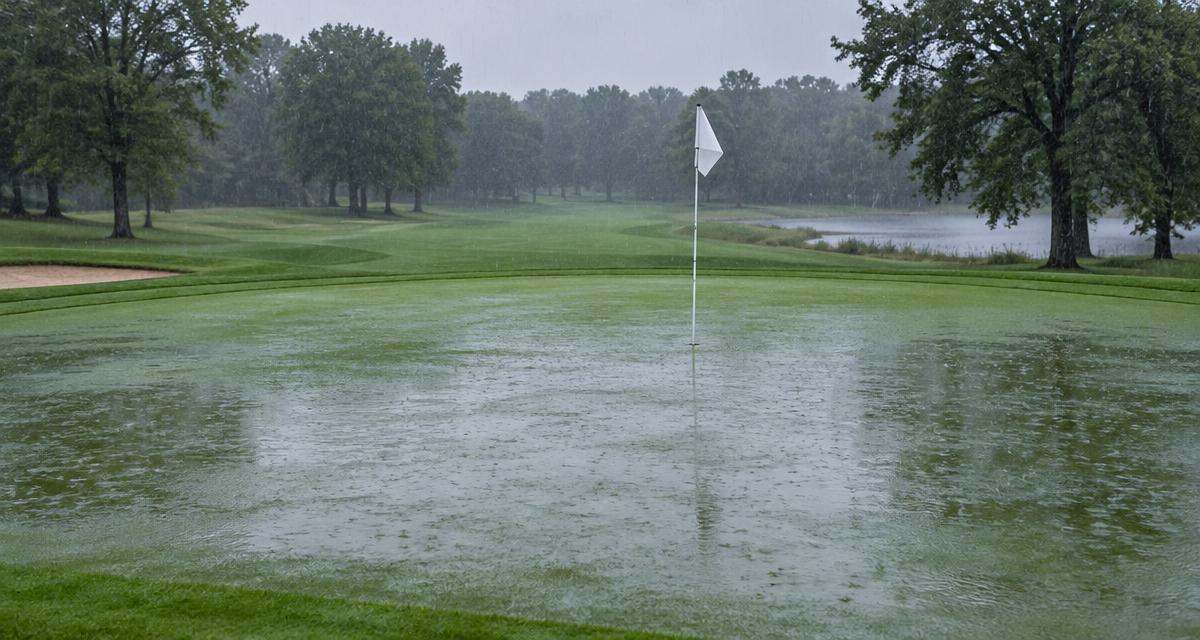
At the course: follow the event’s officials and designated shelter instructions. A weather forecast, clearing sky or horn explanation here is not an all-clear. Do not return simply because the rain has eased.
A suspended round ordinarily continues from where it stopped. Rule 5.7c requires players to be at the directed place and ready at the Committee’s resumption time—not simply to start playing whenever conditions seem better.
Rule 5.7d allows a player to mark and lift the ball when stopping under the rule. If lifted, it must be replaced on its original spot on resumption; the original ball or another ball may be used. If the original spot is not known, it must be estimated. The rule also addresses a ball or marker moved during the interruption.
Worked example: a player is partway through the seventh hole when the immediate-suspension horn sounds. They stop without playing another stroke. If that round resumes the following morning, they return to the relevant spot on seven—not the first tee—and finish the same round under the Committee’s instructions.
A suspension is different from a cancelled round. Committee Procedures 6E(4) separately addresses whether a round should be cancelled. Do not assume scores have been erased because the broadcast says “play suspended”.
The 2026 PGA Tour bad-weather guidelines prioritise completing 72 holes. If that cannot be achieved by Sunday, play will be extended to Monday if course conditions and the forecast permit. That condition matters: a Sunday suspension is not an unconditional promise of a Monday finish. The guidelines also allow efforts to complete 36 holes on Sunday.
If 72 holes becomes impossible, the next priority is 54 holes and an official victory, with Monday extension again subject to conditions and weather. If 54 is impossible, the next priority is 36 holes and official money; in that situation play may extend to Monday.
The handbook’s Tournament Regulations §9 distinguishes official money from official wins. For ordinary 18-hole rounds at a single course:
| Completed | Official money | Official win |
|---|---|---|
| 2 rounds / 36 holes | Yes | No |
| 3 rounds / 54 holes | Yes | Yes |
Multi-course exceptions: for official money, events over three or more courses require an official round on each course; for official wins, the corresponding exception applies at four or more courses. These are Tour classification rules, not sportsbook action rules. Do not apply them automatically to majors, other tours or a different season’s regulations.
No. The ordinary Tuesday exception concerns a final round suspended on Monday when at least half of that final round’s starting field has completed the round. Officials do not restart merely to reach that halfway threshold; if Tuesday completion is impossible, scores revert to the last completed round. THE PLAYERS and FedExCup Playoff events have separate Commissioner discretion to extend as needed to finish 72 holes. See the handbook’s printed pages 53–54 for the full extension provisions, including the limited whole-event rescheduling exception.
This page explains the rules; it is not a live suspension-status service. Check PGA Tour’s official coverage and the tournament’s own notices for today’s decision.
Not automatically. A horn is a playing instruction, not a sportsbook settlement instruction. An outright winner, round matchup, tournament matchup and player prop may have different completion or participation terms. An official shortened result does not prove that every market on that event has action.
Keep the exact market name, relevant house-rule version and official event result. Read the golf-specific shortened-event and round-completion provisions in the rules applicable to your ticket. We have not verified a current cross-book golf settlement comparison here.
Our sportsbook weather-delay settlement guide explains market distinctions, clock anchors and jurisdiction checks using baseball and football examples. Its numerical thresholds must not be applied to golf.
A forecast based on the original tee times may no longer describe when players are actually on the course. If a morning group restarts in the afternoon, or finishes the next day, recheck the new local playing window rather than relying on the original morning/afternoon label.
Our PGA Tour wind-wave study compares modelled wind windows anchored to scheduled tee-time hours. It is not a suspension-adjusted replay of every player’s actual time on the course, and it does not establish a profitable delay-betting strategy.
Use the course weather pages to inspect hourly wind, gusts and rain at the course. The windiest PGA Tour courses ranking describes sampled historical tournament weather—not the probability that today’s round will be suspended.
The horn and player-procedure explanations use the general Rules of Golf and official Committee guidance. They are not a newly measured study, a live lightning alert or a substitute for an event’s Local Rules. No independent reviewer is attributed to this guide.
General Rules of Golf: when a player must stop, options during a normal suspension, and resuming from where play stopped.
Standard model air-horn signals. The Committee must communicate the signals used for its competition.
Official guidance on dangerous weather, unplayable courses, visibility, wind, resumption and cancelling a round.
May 18, 2026 edition: printed pages 53–54 (bad-weather extensions), 56 (Tour horn signals), and 134–135 (shortened events and official money/wins). Scope: PGA Tour cosponsored/coordinated events, not a universal rule for majors or other tours.
Spectators should watch on-course weather messages and follow tournament shelter or exit instructions and local event procedures.
Checked October 31, 2026 against the R&A rule text and May 18, 2026 PGA Tour handbook. The current USGA Rule 5 page blocked automated access; the equivalent current R&A text was read instead. Individual sportsbooks’ golf policies are not established by these sources. If a rule changes or you spot a discrepancy, send the official source to support@overunderweather.com.