Below the grass
Heating pipes help manage soil temperature and the winter playing surface.
Above the grass
Cold air, wind and precipitation remain part of an outdoor game.
Which NFL fields have documented heating?
These are verified examples from official team accounts, not a complete list of every heated NFL stadium. The source dates matter: a documented installation is not a fresh inspection or a live report of whether the system is running today.
Lambeau Field
Green Bay Packers
More than 30 miles of radiant heating pipe and thermostats beneath the field. The team says the system can keep the field from freezing.
Evidence: 2003 team fact sheet; later upgrades documented in 2006 and 2017.
Packers: Lambeau Field Fun FactsArrowhead Stadium
Kansas City Chiefs
A $2.2 million system, completed in spring 2016, circulates boiler-heated water through pipes beneath the playing surface to warm the sand and soil.
Evidence: December 2016 installation account.
Chiefs: heating-system installationLincoln Financial Field
Philadelphia Eagles
The team describes 28 miles of heating pipes, 11 inches deep, arranged in six zones and monitored with 24 soil thermometers.
Evidence: January 2018 groundskeeping account.
Eagles: The Making of a Playing Surface at the LincAcrisure Stadium
Pittsburgh Steelers
The media guide describes approximately 40 miles of three-quarter-inch piping beneath the root zone to heat the soil. This is a dated specification, not confirmation of the current surface or unchanged pipe layout.
Evidence: 2023 team media guide.
Steelers: 2023 media guide, printed page 7 (PDF)How does under-field heating work?
In the Chiefs’ account, boilers heat water that circulates through pipes under the playing surface. The water warms the surrounding sand and soil. A thermostat controls when the system runs, with settings that can change through the year.
The job is groundskeeping, not outdoor central heating. The Chiefs describe using it to help grow grass and keep the soil soft, including use as early as September. The Eagles’ account similarly describes soil monitoring and winter grass maintenance.
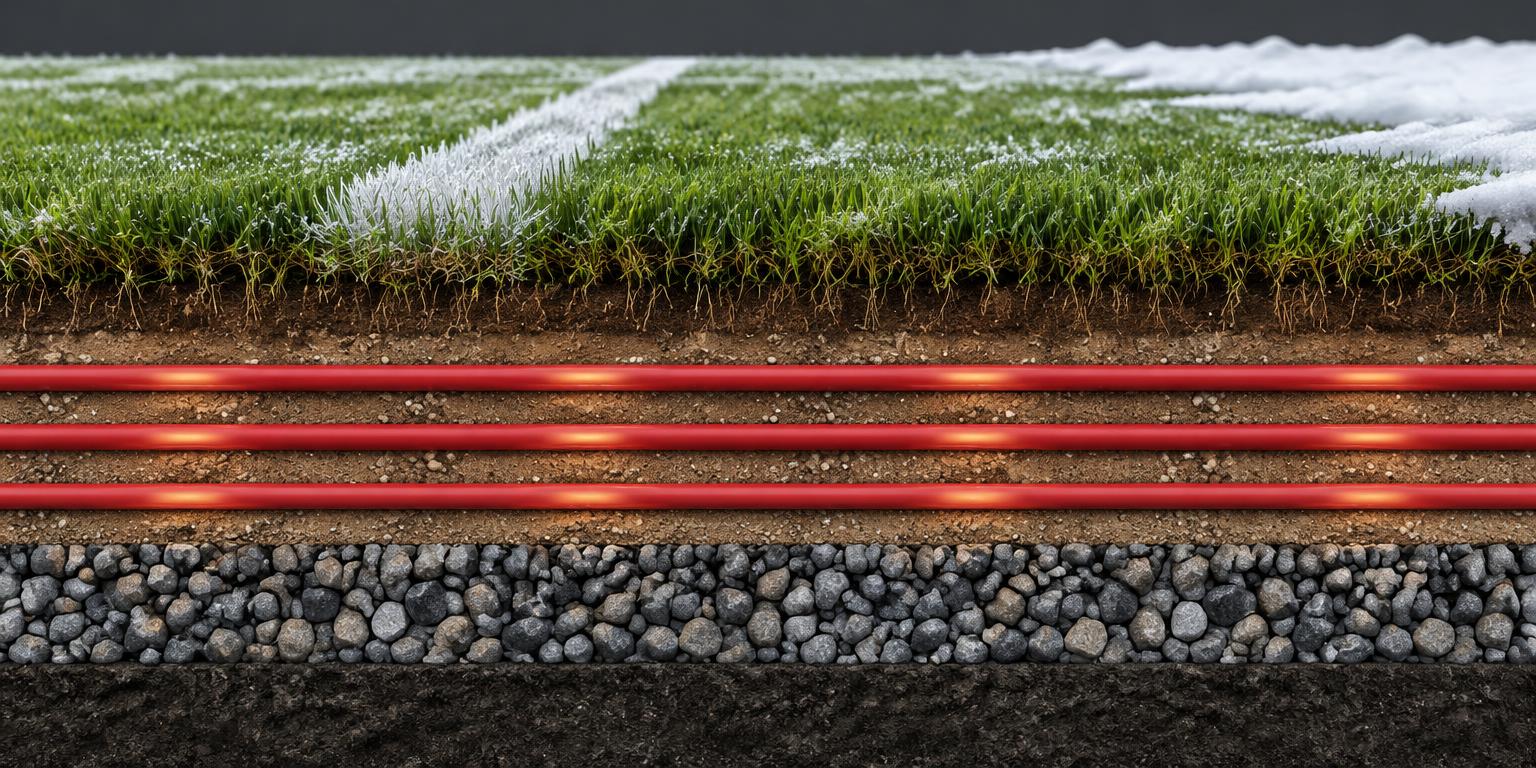
Do not confuse warm circulating water with a measured playing-surface temperature. Boiler-water temperature, soil readings, the grass surface and the air above it are different measurements. This guide does not report a current field-temperature reading.
Is Lambeau Field heated—even the “Frozen Tundra”?
Yes. The Packers’ fact sheet describes more than 30 miles of radiant heating pipe with thermostats beneath the field. That pipe figure comes from a 2003 page, not a newly measured 2026 installation.
Later team records confirm the continuing role of ground heat: the 2006 field-upgrade announcement describes a new drainage and heating system, while the 2017 replacement announcement describes improvements to the underlying heating systems. Those later accounts do not supply a new pipe-mileage total.
The nickname is not a description of every modern game-day surface. Nor does ground heat make Green Bay warm: players and spectators are still outdoors. Our Lambeau cold-weather analysis answers a different question—whether colder home games show an extra Packers advantage.
What about Buffalo’s new Highmark Stadium?
Be careful which Highmark Stadium a source means. The Bills’ September 2026 grass-replacement account describes natural Kentucky bluegrass at the new venue. An older statement about the previous stadium’s artificial surface does not describe that field.
For the field itself, New York’s official project program statement (PDF, printed pages 12–13) specifies a “rootzone piping hydronic system for playing field heat.” It says the system is intended to condition the root zone for grass growth and offseason on-field events. That establishes a project requirement; it is not a commissioning certificate or proof of the system’s operating status today. The execution-version document does not give a verified publication date.
The Bills also describe radiant heat at gathering points throughout the concourses. That is a separate spectator-comfort feature, not the field’s heating system.
Does a heated field remove snow or weather risk?
It does not turn an outdoor stadium into a dome. Ground heating is one part of preparing the surface. Tarps, drainage, snow removal and inspection are separate jobs. In the same account that describes Arrowhead’s underground system, the Chiefs discuss blowing warm air under a tarp to manage condensation and ice.
A heated field is therefore not a guarantee of a snow-free field throughout a storm, or proof that the entire surface is dry, unfrozen or ready for play. It cannot stop falling snow, cancel wind or tell you the traction at a particular spot.
For a game-day decision, check the NFL kickoff forecast and the actual field report. Our NFL snow guide and kicking-weather guide keep those weather effects separate. We have not tested heated versus unheated fields against scoring, injuries or closing betting lines; no fixed points adjustment follows from this guide.
Common questions
- Are all NFL fields heated?
- Do not assume that. The official accounts above establish individual systems, not a league-wide rule or a complete count. Missing documentation is not proof that another field has no heating.
- Does real grass mean the field is heated?
- No. Surface material and underground infrastructure are separate facts. Our NFL grass-versus-turf guide identifies surfaces; it is not a heating inventory.
- Does artificial turf tell you whether a field is heated?
- No. A synthetic surface label does not establish the presence or absence of an underground heating system. Verify the particular venue’s construction and operating records; this guide’s documented team examples concern grass fields.
- Are heated benches the same thing?
- No. Bench heaters and sideline warming equipment warm people or equipment near the sideline. Under-field systems warm the ground. Evidence of one is not evidence of the other.
Sources and limits
Sources checked 31 October 2026. We read the linked Packers, Chiefs, Eagles, Steelers and Bills accounts and New York’s project specification, retaining their historical context. This is a descriptive venue guide, not a new statistical study, a field-safety assessment or an independently reviewed heating survey.
We have not established a complete current inventory, operating temperatures, energy bills or the heating status of every NFL venue. In particular, Denver is not classified here because we did not verify an official field-heating account. Source access and published installation details cannot substitute for a current engineering inspection.